Market and documentary data for LLM systems
2026 source map, programmatic SEC EDGAR, news and sentiment, and point-in-time pipelines without traps.
Learning objectives
Upon completing this module, the reader will be able to:
- Distinguish the families of financial data sources in 2026 (institutional terminals, enterprise feeds, developer-first APIs, public regulatory sources) and size their real cost, including programmatic access and exchange non-display fees.
- Assess whether a source is licensed to feed prompts and vector stores in commercial production, and rule out those that are not (the yfinance case).
- Consume SEC EDGAR through its real JSON endpoints (
submissions,companyfacts,companyconcept,frames, full-text search), respecting rate limits and the User-Agent policy. - Build LangChain tools on top of those sources, ready for the agents of the later modules.
- Design a point-in-time pipeline —WebSocket → Kafka → TimescaleDB (serving) + Parquet/DuckDB (backtest) + Feast— applying the rule "text to the vector store, numbers to SQL".
- Detect and neutralize the traps that invalidate backtests with fundamentals: look-ahead from restatements, reporting lag and survivorship bias.
Module 3 gave agents orchestration: state graphs, tools, persistence and human interrupts. But an agent is only as good as the data its tools serve it. This module opens Block II (understand) by building that foundation: which market and documentary sources exist in 2026, which license is needed to feed an LLM with them, how they are consumed programmatically, and how they are organized in a point-in-time architecture that the RAG of Module 5 and the calculations of Modules 7 and 8 can audit.
4.1 The source landscape in 2026
4.1.1 Institutional vs accessible
The financial data market in 2026 is stratified into two worlds that barely touch. In the first, the institutional terminals: as of July 2026 Bloomberg Terminal lists at around \(31{,}980 per seat per year (\)28{,}320 in multi-seat configuration), after the 6.5% increase applied to renewals since January 2025 (Github) . LSEG Workspace (successor to Refinitiv Eikon) sits above $22{,}000 per seat in its full version, with a reduced edition close to $4{,}000 per year (Github) . FactSet, with a historical list price of $12{,}000, shows real contracts averaging close to $45{,}000 per year according to buyer transactional data (arXiv.org) . S&P Capital IQ Pro moves in the \(12{,}000–\)20{,}000 per seat band (arXiv.org) . These figures are industry estimates —none of the four vendors publishes price lists—, but they converge across two independent sources and are accepted as a budgetary reference (arXiv.org) .
The decisive fact for an LLM systems engineer is different: the terminal subscription does not include programmatic access. Feeding an automated pipeline —and therefore a LangChain agent— with Bloomberg data requires B-PIPE (\(2{,}000–\)3{,}000/month) or Data License (\(5{,}000–\)50{,}000+/year); extracting terminal content into a vector store or a prompt without that license breaches the contract (arXiv.org) .
In the second world, developer-first APIs have reached a coverage that five years ago was exclusive to the buy-side. The structural milestone is the renaming of Polygon.io as Massive.com, effective October 30, 2025: the api.polygon.io keys and endpoints remain operational in parallel with api.massive.com, and CME/CBOT/COMEX/NYMEX futures, Benzinga data and an llms.txt file in the documentation for consumption by AI assistants were added (Quant Memo) . Its plans run from free EOD to $199/month real time and $2{,}000/month Business with a commercial license (Picture Perfect Portfolios) . Alpha Vantage gives 25 free requests per day and premium tiers from $49.99 to $249.99/month scaled by req/min, with the caveat that U.S. real time requires an additional entitlement (MDPI) . Tiingo covers 30+ years of EOD for \(30/month (\)50/month for the commercial-use Business plan) (A.L. Capital Advisory) . Databento distributes direct exchange data (not SIP) with 6.1-microsecond normalization and MBO/MBP-10 schemas in nanoseconds, from \(199/month [(pfolio.io)](https://www.pfolio.io/academy/tangency-portfolio) . Nasdaq Data Link operates as a marketplace with free economic datasets and à-la-carte premium ones (\)50–$500+/month) (Entropy Method: Solving RL Without Gradients) .
Table 4.1 — Institutional vendors vs accessible APIs (prices as of July 2026)
| Source | Main coverage | Latency | Reference price | License for LLM use |
|---|---|---|---|---|
| Bloomberg Terminal + B-PIPE/Data License | Global multi-asset, news, estimates | Real time (ms) | ~$31{,}980/seat/year + \(2{,}000–\)3{,}000/month (B-PIPE) (Github) | Only via explicit data license; AI addendum to be negotiated (medium-high confidence: industry estimate) |
| LSEG Workspace + Data Platform | Global multi-asset, Reuters News | Real time | ~$22{,}000+/seat/year; APIs separate (Github) | Requires redistribution/API license (medium-high confidence) |
| FactSet | "Scrubbed" fundamentals, estimates, supply chain | Real time / EOD | List ~\(12{,}000; real contractual average ~\)45{,}000/year (arXiv.org) | Additional fees for integration into proprietary systems and non-licensed users (arXiv.org) |
| Massive (formerly Polygon.io) | Equities, options, forex, crypto, futures | Free EOD; 15 min $29/month; RT $199/month | \(0–\)2{,}000/month (Picture Perfect Portfolios) | Commercial use/redistribution only on Business plan; llms.txt in docs (Picture Perfect Portfolios) |
| Alpha Vantage | Equities, forex, crypto, indicators, news | Free EOD; RT via entitlement | \(0 (25 req/day)–\)249.99/month (MDPI) | Commercial terms on request; official MCP server (MDPI) |
| Tiingo | 30+ years adjusted EOD, IEX intraday | EOD; IEX real time | $30/month (Power); $50/month (Business) (A.L. Capital Advisory) | Business plan covers internal commercial use (A.L. Capital Advisory) |
| Databento | L0–L3 direct from exchange, 21,000+ products | Nanoseconds (6.1 µs normalization) | $199/month (Standard); $4{,}000/month (unlimited US Equities) (pfolio.io) | Institutional grade; terms by plan (pfolio.io) |
| Nasdaq Data Link | Marketplace: economic, fundamentals, alternative | Varies by dataset | Free (FRED)–$500+/month per dataset (Entropy Method: Solving RL Without Gradients) | License per dataset; review each one (Entropy Method: Solving RL Without Gradients) |
| yfinance (Yahoo, unofficial) | EOD and limited intraday | Delayed | $0 (Ask Everything) | No: personal use only per ToS; no SLA (Ask Everything) |
Interpretation. The table reveals three asymmetries. First: the scale factor between the two worlds is two to three orders of magnitude —a desk with Tiingo + Massive Business costs less per year than a single Bloomberg seat—, but what the institutional premium buys is not the data but the license, support and consolidated coverage. Second: the "LLM license" column decides the viability of an agentic project, not the price: every institutional row demands explicit negotiation before a single token enters a prompt, and only some accessible APIs (Massive Business, Tiingo Business) include it out of the box. Third: latency at developer prices already covers any strategy below aggressive intra-day; Databento even opens the door to microstructure. Operational conclusion: the pipelines of modules 5 to 8 can be built on the accessible half of the table, keeping the institutional vendors as the scaling path once the license is approved.
In plain terms: you are not buying the data, you are buying the license
Think of the difference between buying a book and buying the rights to photocopy it and distribute it inside your company. The price of a Bloomberg terminal does not pay for information that does not exist elsewhere —stock prices are the same on every screen in the world—; it pays for the contractual right to use it, for support when a field fails on a Sunday night, and for consolidated coverage of millions of instruments. That is why Table 4.1 shows a factor of two to three orders of magnitude between the two worlds without either being "better" in the abstract: a small quant desk can operate legally with Tiingo Power and Massive Business for less per year than a single Bloomberg seat costs, as long as its strategy does not demand institutional coverage or latency.
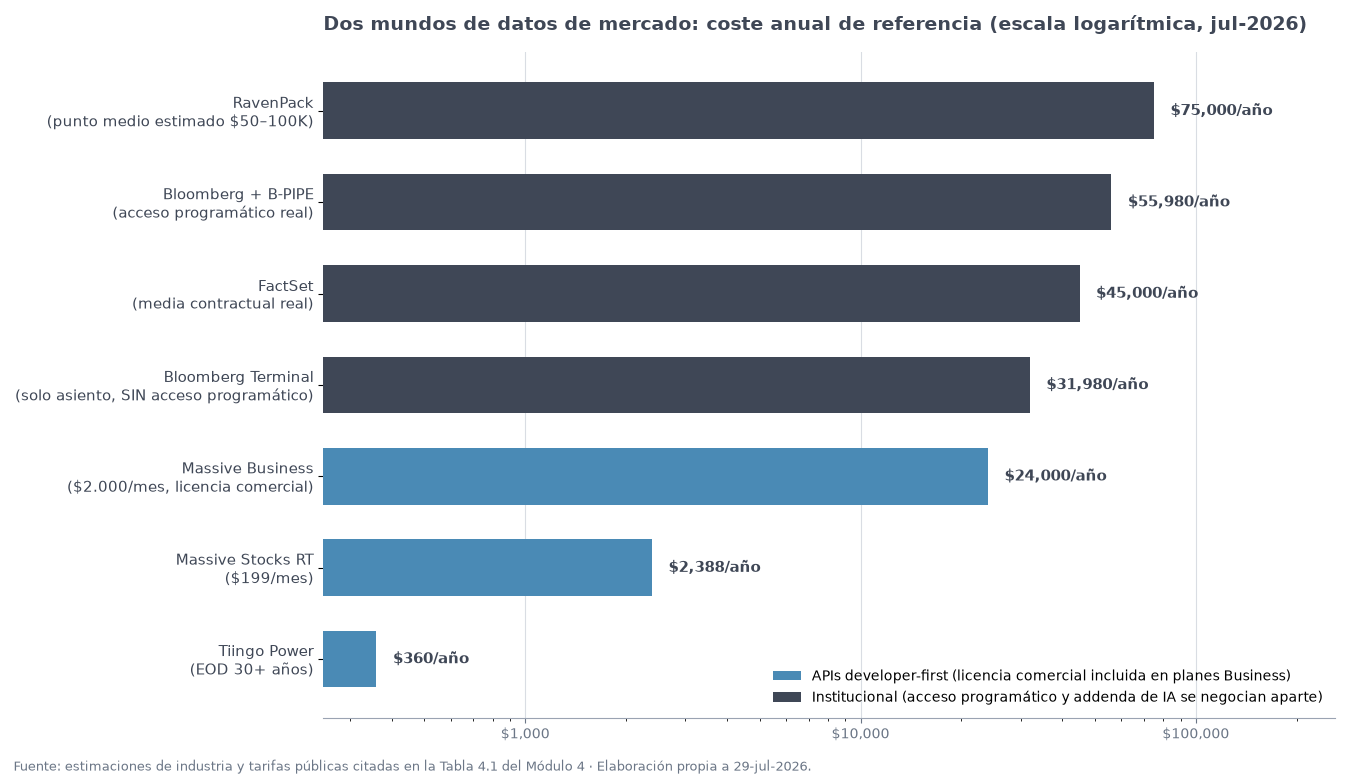
The figure uses a logarithmic scale on purpose: on a linear scale the three developer-first bars would be invisible next to the institutional ones. Notice also the jump within the Bloomberg world itself: the seat alone (no programmatic access) and the seat plus B-PIPE are different products, and only the second can legally feed an automated pipeline.
4.1.2 Licenses for LLM use: non-display, AI addenda and the yfinance case
Three contractual mechanisms determine whether a data point may enter a production LLM system.
The first is the exchange non-display fee: the consumption of market data by machines —algorithms, servers and, explicitly, LLM agents that generate signals— rather than by a human looking at a screen. The official NYSE guide sets $3{,}000/month for category 1 non-display on NYSE Trades and $5{,}000/month on the NYSE National Integrated Feed, with a category 3 that covers trading signals and ATSs (alanhou.org) . A LangChain agent whose tool queries a real-time feed falls, in the exchange's eyes, within this definition: it is the most frequent budget surprise in AI projects with market data (alanhou.org) .
The second mechanism is the vendors' AI addenda. Bloomberg, LSEG, FactSet and S&P contracts license data for internal use by licensed users; sending that content to a third-party LLM (where it may remain in logs) or to a vector store accessible by unlicensed staff enters prohibited territory absent an explicit "AI/derived data use" addendum (arXiv.org) . The counterpart: the accessible vendors formalize the reverse channel —official MCP servers from Alpha Vantage and Benzinga, llms.txt at Massive— which turns their APIs into agent-discoverable sources (Quant Memo) .
The third is the negative litmus test: yfinance. Yahoo shut down its public API in 2017; the library scrapes unofficial endpoints, saturates under load (~2{,}000 estimated requests/hour before the 429 error), its terms of service limit it to personal use and it lacks any SLA (Ask Everything) .
Risk note. Using yfinance as a tool of an agent in commercial production violates Yahoo's terms of service (personal use only) and is structurally fragile: the February 2025 web redesign broke production scripts overnight, and 1-minute intraday only covers 7 days (Ask Everything) . For teaching and prototyping it is valid; for systems feeding real decisions, the minimum defensible source is an API with a commercial license (Massive Business, Tiingo Business, Databento) or EDGAR, public by law. Migrating to Tiingo Power costs $30/month: there is no economic justification for taking on the contractual risk.
In institutional practice. On the desks that have industrialized LLMs, license review happens before architecture review. The approval checklist for an agentic pipeline includes: (1) entitlement and non-display category declared to the exchange; (2) signed AI addendum or confirmation that the plan covers internal redistribution; (3) storage segregation —the vector store holding licensed data is accessible only to licensed users—; (4) lineage: every agent answer must be traceable to its source and its license. A technically perfect pipeline on poorly licensed data is a regulatory liability, not an asset.
Common pitfall: "I have an API key" does not mean "I can put it in a prompt"
The most frequent budget error in AI projects with market data is assuming that paying for a feed grants the right to consume it with machines. In the exchange's eyes, a LangChain agent whose tool queries real-time quotes is non-display consumption —the same as an execution algorithm— and is billed separately: the NYSE guide cited in §4.1.2 sets USD 3,000/month in category 1 on NYSE Trades and USD 5,000/month on the NYSE National Integrated Feed, with a category 3 that explicitly covers trading signals. The team finds out when the exchange's letter or the vendor's audit arrives, never during development.
The symmetric version on the vendor side: dumping licensed content into a vector store accessible to unlicensed staff, or sending it to a third-party LLM where it may remain in logs, breaches the contract absent an explicit "AI/derived data use" addendum. The module's institutional checklist exists precisely because these two surprises —non-display and addendum— show up after the pipeline is built, when rebuilding it costs months. Operational lesson: the question "is this data point licensed to enter a prompt?" comes before any architecture decision, and its answer is documented next to each source's lineage.
4.2 SEC EDGAR as a programmatic source
4.2.1 Real endpoints: submissions, companyfacts, companyconcept, frames and full-text search
EDGAR is the only major financial source that combines three properties: free, no API key, and direct legal value (filings are regulatory documents). In return, the SEC asks for a descriptive User-Agent with a contact email and a maximum of 10 requests per second; for massive backfills it recommends the nightly ZIPs rather than hammering per-company endpoints (arXiv.org) . The first step of any pipeline is to cache https://www.sec.gov/files/company_tickers.json, which resolves ticker → CIK locally (ResearchGate) .
Table 4.2 — SEC EDGAR endpoints (verified as of July 2026)
| Endpoint | URL | Purpose | Rate limit |
|---|---|---|---|
| Submissions | https://data.sec.gov/submissions/CIK##########.json |
Company metadata + complete filing history (forms, dates, accession numbers, links) (TL;DR Filing) | 10 req/s global SEC (arXiv.org) |
| CompanyFacts (XBRL) | https://data.sec.gov/api/xbrl/companyfacts/CIK##########.json |
All XBRL facts (us-gaap, dei, ifrs-full, srt) ever filed, with filed per fact (ResearchGate) |
10 req/s (arXiv.org) |
| CompanyConcept | https://data.sec.gov/api/xbrl/companyconcept/CIK{cik}/{taxonomy}/{tag}.json |
History of a single concept (small payload) (ResearchGate) | 10 req/s (arXiv.org) |
| Frames | https://data.sec.gov/api/xbrl/frames/{taxonomy}/{concept}/{unit}/{period}.json |
One concept for all companies in a period (cross-section, e.g. CY2023Q4I) (ResearchGate) |
10 req/s (arXiv.org) |
| Full-Text Search (EFTS) | https://efts.sec.gov/LATEST/search-index?q=... |
Boolean search across the text of all filings; forms, dateRange, size ≤ 100 filters (Apify) |
10 req/s (arXiv.org) |
| Ticker→CIK | https://www.sec.gov/files/company_tickers.json |
Local ticker/CIK/name lookup (ResearchGate) | Cache it (changes rarely) |
| Bulk archives | Nightly ZIPs at data.sec.gov | Massive historical backfills (arXiv.org) | Recommended use for initial load |
Interpretation. The XBRL family (XBRL: eXtensible Business Reporting Language, the financial-fact tagging standard mandated by the SEC) makes EDGAR a first-order source for LLM systems: every figure arrives structured with taxonomy, unit, period and —critical for section 4.4— the filed date on which it became public, the basis of any point-in-time reconstruction (ResearchGate) . companyfacts is the workhorse for a company's fundamentals; companyconcept minimizes tokens when the agent only needs one metric (a full companyfacts can exceed the context window); frames enables cross-sectional screening —comparing NetIncomeLoss across the whole universe for a quarter with one call—, the exact pattern of quantitative queries (ResearchGate) . EFTS is the discovery index of the documentary pipeline in Module 5: locating every filing that mentions "material weakness" in risk factors costs one HTTP request (Apify) .
The following snippet implements access to submissions while respecting SEC policy:
import time
import requests

SEC_HEADERS = {"User-Agent": "QuantResearch [email protected]"}  # mandatory
RATE_LIMIT_S = 0.12  # ~8 req/s, margin below the official 10 req/s maximum

def get_submissions(cik: int) -> dict:
    """Complete filing history of a company (columnar parallel arrays)."""
    url = f"https://data.sec.gov/submissions/CIK{cik:010d}.json"
    resp = requests.get(url, headers=SEC_HEADERS, timeout=20)
    resp.raise_for_status()
    time.sleep(RATE_LIMIT_S)
    return resp.json()

subs = get_submissions(320193)  # Apple
recent = subs["filings"]["recent"]
# form[i], filingDate[i] and accessionNumber[i] share an index (columnar format)
primer_10k = next(
    i for i, f in enumerate(recent["form"]) if f == "10-K"
)
print(recent["form"][primer_10k], recent["filingDate"][primer_10k],
      recent["accessionNumber"][primer_10k])
# Document URL: https://www.sec.gov/Archives/edgar/data/
#   {cik_no_zeros}/{accession_no_dashes}/{primaryDocument}
And this is the LangChain tool pattern over companyconcept —the first real tool of the course, which the agents of modules 3 and 7 will consume directly:
from langchain.tools import tool
import requests

@tool
def get_xbrl_concept(ticker: str, concept: str = "NetIncomeLoss") -> str:
    """Returns the history of a us-gaap XBRL concept for a company (SEC EDGAR).

    Each fact includes period (end), value (val), form (form) and,
    critically, the publication date (filed) for point-in-time joins.
    """
    cik = resolve_cik(ticker)  # cached lookup from company_tickers.json
    url = (f"https://data.sec.gov/api/xbrl/companyconcept/"
           f"CIK{cik:010d}/us-gaap/{concept}.json")
    r = requests.get(url, headers={"User-Agent": "QuantApp [email protected]"},
                     timeout=20)
    r.raise_for_status()
    units = r.json()["units"]
    return str(units)[:4000]  # truncate: token and cost control
Best practices separate a production tool from a demo: a precise docstring (the LLM chooses the tool by its description), input validation with pydantic, output truncation, compact JSON instead of HTML, actionable errors and retries with backoff in the face of 429s from GDELT, Yahoo or Alpha Vantage (Apify) .
Worked example: from ticker to filing URL in four steps
The module's get_submissions snippet hides four details worth fixing in mind before writing your own tools. Full walkthrough with Apple, using the same pieces from the course (requests, SEC_HEADERS, rate-limit pause):
import time
import requests

SEC_HEADERS = {"User-Agent": "QuantResearch [email protected]"}  # mandatory
RATE_LIMIT_S = 0.12  # ~8 req/s, margin below the official 10 req/s maximum

# STEP 1 — ticker → CIK with the cached file: one download, a thousand lookups
tickers = requests.get("https://www.sec.gov/files/company_tickers.json",
                       headers=SEC_HEADERS, timeout=20).json()
cik = next(v["cik_str"] for v in tickers.values() if v["ticker"] == "AAPL")
# cik == 320193 (integer, no leading zeros)

# STEP 2 — submissions: the CIK is formatted to 10 digits with leading zeros
subs = requests.get(f"https://data.sec.gov/submissions/CIK{cik:010d}.json",
                    headers=SEC_HEADERS, timeout=20).json()
time.sleep(RATE_LIMIT_S)

# STEP 3 — columnar format: form[i], filingDate[i], accessionNumber[i]
# and primaryDocument[i] are parallel arrays traversed with the same index
recent = subs["filings"]["recent"]
i = next(j for j, f in enumerate(recent["form"]) if f == "10-K")

# STEP 4 — document URL: CIK WITHOUT zeros and accession WITHOUT dashes
accn = recent["accessionNumber"][i].replace("-", "")
url = (f"https://www.sec.gov/Archives/edgar/data/{cik}/"
       f"{accn}/{recent['primaryDocument'][i]}")
Three real failures when implementing this for the first time: forgetting the ten-digit format in the submissions URL (immediate 404), treating recent as a list of objects when they are parallel arrays, and building the Archives URL with the accession number still containing dashes. The same discipline from the module then applies to companyconcept: a precise docstring (the LLM chooses the tool by its description), output truncated to 4,000 characters and the filed date always visible in the payload, because it is the key to the point-in-time joins of Module 8.
4.3 News, sentiment and alternative data
4.3.1 GDELT, Benzinga, Alpha Vantage; MCP; Form 4 and 13F; deduplication and alpha decay
The news ecosystem has a well-known price cliff: NewsAPI.org is free only in development (100 req/day, 24 h delay) and jumps to $449/month on Business —and even paid tiers do not deliver full article bodies (Github) . The structural alternative is GDELT, free and keyless: the DOC 2.0 API (https://api.gdeltproject.org/api/v2/doc/doc) monitors press, web and broadcast in more than 100 languages at a 15-minute cadence, with ArtList, TimelineVol (breaking news detection by volume) and ToneChart modes, 250 records per query and aggressive rate limits that demand caching (Fundamentals Hub) . In affordable paid territory, Benzinga distributes its real-time wire, ratings with history since 2012, earnings and guidance via Massive for $99/month per package, and launched its MCP server in November 2025 (templates) . In the institutional segment, RavenPack processes more than 40{,}000 sources with more than twenty sentiment indicators and 20+ years of archive for an estimated \(50{,}000–\)100{,}000+ per year (medium confidence: no public price), without covering social media (TL;DR Filing) .
Table 4.3 — News and sentiment sources (as of July 2026)
| Source | Coverage / latency | Price | MCP server? | Notes for agents |
|---|---|---|---|---|
| GDELT DOC 2.0 API | 100+ languages, 15 min cadence, ArtList/Timeline/ToneChart modes | $0, no key; frequent 429s (Fundamentals Hub) | Yes (MissionSquad/mcp-gdelt, community) (Fundamentals Hub) | Caching and dedupe mandatory; ~3-month window in DOC API |
| Benzinga (via Massive) | Real-time wire, ratings since 2012, earnings, guidance | $99/month per package; Pro \(37–\)197/month (templates) | Yes, official (Nov 2025) (Cambridge University Press & Assessment) | Structured JSON per event; official Python client |
| Alpha Vantage NEWS_SENTIMENT | Headlines + sentiment scores per ticker | Included in premium $49.99+/month (MDPI) | Yes, official (MDPI) | Convenient for prototypes; check archive depth |
| NewsAPI.org | Headlines/descriptions; archive 1 month (free) to 5 years | $0 dev → $449/month Business; no full-text (Github) | Community | Dev→production cliff; separate scraping for body |
| RavenPack / Bigdata.com | 40{,}000+ sources, ESS, 13 languages, ms latency | ~$50–100K+/year estimated (TL;DR Filing) | Own agentic platform | Standard at systematic hedge funds; no social media |
| SEC Form 4 / 13F (EDGAR) | Insiders (2 business days) / holdings (45-day delay) | $0 (Apify) | No | Regulatory signal; see timing caveats below |
Interpretation. The reading of the table is that the cost of news is not in the API but in the downstream processing: GDELT is free but returns noise and republications that must be deduplicated before an LLM counts volume as signal; Benzinga charges to deliver the event already structured (rating action, price target, firm) (templates) . The availability of official MCP servers in three accessible rows is the 2026 change with the greatest architectural impact: a LangGraph agent discovers GDELT, Benzinga and Alpha Vantage as tools without custom wrappers, although the underlying quota and entitlement still apply (MDPI) . Finally, the GDELT-vs-Benzinga-vs-RavenPack choice is not about quality but about budget and latency: for daily research, GDELT with dedupe is enough; for intra-day signal with time value, the structured wire justifies its price.
Real GDELT query:
import requests

def gdelt_artlist(query: str, timespan: str = "1week", maxrecords: int = 50) -> list[dict]:
    """Recent articles from GDELT DOC 2.0 (no API key; respect ~6 s between calls)."""
    params = {"query": query, "mode": "artlist", "format": "json",
              "timespan": timespan, "maxrecords": maxrecords}
    r = requests.get("https://api.gdeltproject.org/api/v2/doc/doc",
                     params=params, timeout=30)
    r.raise_for_status()
    arts = r.json().get("articles", [])
    seen, out = set(), []
    for a in arts:  # dedupe by URL/title: wire agencies republish the same news item
        key = a.get("url", a.get("title"))
        if key not in seen:
            seen.add(key)
            out.append(a)
    return out
Two regulatory sources deserve separate mention. The insider Form 4 is filed within two business days of the transaction: it is the freshest legally mandated signal in the U.S. market —insider behavior appears there before it does in 13F, research notes or the press—, with free XML on EDGAR and APIs such as sec-api.io that structure it (Apify) . The 13F, by contrast, reflects quarter-end positions published with a 45-day delay, long-only in 13(f) securities —no shorts and most derivatives excluded—: historical context, never current positioning (TL;DR Filing) .
On exploiting sentiment, two empirical caveats. The first is deduplication: wire agencies republish the same story dozens of times, and counting volume without URL/title dedupe inflates the signal (orthogonal.info) . The second is alpha decay: the performance of a sentiment signal decays with its adoption, forcing continuous regeneration of variants (orthogonal.info) . A common working model is exponential decay
where \(\lambda\) grows with the diffusion of the signal; the half-life \(t_{1/2}\) of public sentiment signals is measured in months, not years (orthogonal.info) .
Common pitfall: measuring "news volume" without deduplication
A signal as naive as "number of articles mentioning NVDA today" is broken before it starts: wire agencies republish the same story dozens of times and GDELT collects them all. A day with a single real news item —an earnings note from one agency, for example— can return 250 records of which barely 90–100 are distinct pieces; the rest is the same piece with a different header and outlet. Without the URL/title dedupe already built into gdelt_artlist, the pipeline counts 250 and concludes "extraordinary news day" when exactly one thing happened.
The contamination is worse than noise: it is noise correlated with the importance of the news, because big stories get republished more. The resulting signal does not measure news volume but the wires' republication speed. The antidote is cheap —a set over the URL or normalized title— but it must be applied before any counting, sentiment scoring or frequency statistic. And even deduplicated, the module's second caveat weighs in: the alpha of a public sentiment signal decays with its adoption (\(\alpha_t = \alpha_0 e^{-\lambda t}\), half-life of months), so dedupe gives you the clean signal, not the eternal signal.
4.4 Point-in-time pipeline architecture
4.4.1 The golden rule of data: "text to the vector store, numbers to SQL"
Everything above converges on a single design decision, the one that organizes the course's reference architecture (structural insight I5) —the golden rule of data, sister of the course's golden rule from §1.2.2, applied to the storage layer—: unstructured text goes to the vector store; numbers go to relational/columnar databases and are queried with deterministic tools. Embeddings are semantic retrieval, not a store of exact figures: an LLM that "remembers" a revenue figure via vector similarity may retrieve the wrong period or distort the number, whereas a SQL query over XBRL returns the value with its filed and its accession number (Apify) . The concrete partition: to the vector store go 10-K/10-Q sections (Item 1A, Item 7), transcripts and full-text news, with {ticker, form, filing_date, section} metadata for pre-retrieval filters; to SQL/columnar go OHLCV, XBRL facts, 13F holdings, Form 4 transactions and estimates; to Redis, the hot state (Apify) . The stack is simplified if the vector store is pgvector inside Postgres/TimescaleDB itself (Apify) .
For numeric transport, the standard pattern is: vendor WebSocket → Python producer → Kafka topics partitioned by symbol (preserves per-asset ordering) → consumers → stores, using the exchange timestamp as event-time so that jitter does not reorder calculations; Kafka's replayability allows regenerating features without re-downloading from the vendor (博客园) . In serving, TimescaleDB (Postgres) provides hypertables and continuous aggregates that pre-compute OHLCV roughly 100 times faster than views over raw ticks, with 90–95% compression (Apify) :
CREATE TABLE tick_data (time TIMESTAMPTZ NOT NULL, symbol TEXT NOT NULL,
                        bid NUMERIC(20,8) NOT NULL, ask NUMERIC(20,8) NOT NULL);
SELECT create_hypertable('tick_data', 'time');

CREATE MATERIALIZED VIEW tick_1m_view WITH (timescaledb.continuous,
  timescaledb.materialized_only = false) AS
SELECT time_bucket('1 minute', time) AS time, symbol,
  FIRST((bid+ask)/2, time) AS open, MAX((bid+ask)/2) AS high,
  MIN((bid+ask)/2) AS low,  LAST((bid+ask)/2, time) AS close
FROM tick_data GROUP BY time_bucket('1 minute', time), symbol;

SELECT add_retention_policy('tick_data', INTERVAL '30 days');
For research and backtesting, the de facto pattern is partitioned Parquet (year=/month=/symbol=) queried with in-process DuckDB —columnar reads with predicate pushdown at zero marginal cost—, reserving TimescaleDB for serving (Entropy Method: Solving RL Without Gradients) . The piece that closes the temporal loop is Feast, a feature store with an offline store (training) and an online store (serving) whose point-in-time join generates datasets with exactly the anti-look-ahead semantics a backtest requires: each feature is joined with the latest value available at the label's instant, not the latest known today (Accuweather Api) .

In plain terms: why numbers do not go in the vector store
An embedding is a mathematical summary of a text's meaning, not a photocopy of its figures. If you store "revenue was 394.3 billion" as a vector, what you retrieve later is similar text —perhaps the wrong quarter, perhaps the figure of another company in the same sector— and the LLM rewrites it with its usual fluency. It is the mechanism of numerical hallucination, now with expensive infrastructure around it. By contrast, a SQL query over the XBRL table returns the exact value with its filed and its accession number: auditable, repeatable and interpretation-free.
The module's partition sums up in one sentence what a desk takes months to learn through incidents: text goes to the vector store with metadata for filtering, numbers to SQL/columnar queried with deterministic tools, and hot state to Redis.

Note the intermediate arrow in the diagram: the agent never "remembers" figures, it asks a tool that executes SQL for them. That is why pgvector inside Postgres itself simplifies the stack so much —a single database holds both halves of the golden rule—.
4.4.2 Data traps: look-ahead, survivorship and point-in-time universes
The availability rule that defines point-in-time (PIT) is simple to state and costly to implement: a fact \(f\) may only feed the decision at simulation time \(t\) if its effective publication date is earlier than or equal to \(t\):
There are three common violations, with distinct antidotes (orthogonal.info) . First, restatements: using the corrected value of a fundamental before the correction was public. The canonical case is Plug Power: diluted loss for fiscal year 2018 was originally reported at $0{,}36 per share and was restated to $0{,}39 in a filing dated May 14, 2021; any 2019 or 2020 simulation using $0{,}39 has leaked two years of future (orthogonal.info) . The SEC's XBRL API gives filed per fact, but shows the latest version of each period —it does not preserve the pre-restatement value—; strict PIT requires Compustat Point-in-Time, Bloomberg's PIT mode, Norgate, engines such as QuantConnect LEAN (fundamentals "as of" the publication date) or a custom versioning layer over accn + filed (orthogonal.info) .
Risk note. Look-ahead in fundamentals is the most silent overestimation in backtests with LLM data: it leaves no exceptions in the logs, the pipeline runs clean and the Sharpe comes out inflated. The Plug Power case ($0{,}36 → $0{,}39) looks harmless until it is multiplied by thousands of XBRL facts restated every year. Sister violation: reporting lag —joining the annual figure to the period close when the 10-K arrives 25–60 days later—. Correct temporal auditing asks one question per input: "at the exact instant this signal fired, could a real operator have known this number?" (orthogonal.info) . If answering requires looking at the filing calendar, the answer is no.
The third violation is survivorship bias: a universe built with today's living tickers has removed the bankrupt, acquired and delisted ones, and never sees the worst outcomes. The magnitude is not minor: in a Morningstar study, 58% of the funds existing in 1999 no longer existed in 2019 (Accuweather Api) . And there is a structural limitation of the cheap stack: APIs such as yfinance or Alpha Vantage do not serve delisted stocks, so a serious long-history backtest requires sources with delistings (Norgate, CRSP) and point-in-time universes that reconstruct the S&P 500 constituents as of each date, not today's (Accuweather Api) . Checklist complements: shift every signal by one bar (anything computed with bar \(N\) cannot be traded until the open of \(N+1\)), exchange versus reception timestamps, halt-gap detection, XBRL null validation and news dedupe (orthogonal.info) .
With this module, the reader has the sources (4.1–4.3) and the temporally honest architecture (4.4) that the later agents will consume: Module 5 (RAG) will be built on the documentary branch of the diagram, and Modules 7 and 8 on the numeric branch and its PIT joins.
Worked example: the Plug Power timeline, step by step
The canonical case of look-ahead by restatement deserves to be seen as a timeline, because the error is not in any single data point but in the order in which the facts became known:
| Date | Event | Diluted FY2018 EPS public at that moment |
|---|---|---|
| Dec 31, 2018 | End of fiscal year 2018 | (not yet published) |
| Mar 2019 | Original 10-K (filed) |
−$0.36 per share |
| Jan 1, 2020 | Moment of the simulated decision | −$0.36 (only known value) |
| May 14, 2021 | Restatement in a later filing (filed) |
−$0.39 per share |
| Today | Naive query to the XBRL API (latest version of the period) | −$0.39 ← the trap |
The module's PIT rule applied to the table: on the decision row (Jan 1, 2020) only what has filed earlier than or equal to that date counts, that is, −\(0.36. Any 2019 or 2020 simulation using −\)0.39 has leaked up to two years of future.
Walkthrough: PLUG's original 10-K (filed in March 2019) reported diluted FY2018 loss at $0.36 per share, and that was the only public value for more than two years. On May 14, 2021 a later filing restated it to $0.39. The SEC's XBRL API —which shows the latest version of each period— returns 0.39 for FY2018 today; a naive "FY2018 EPS" query injects it into a 2019 or 2020 simulation and the future leaks in without a single exception in the logs. That is why the module's risk note calls it the most silent overestimation: the pipeline runs clean and the Sharpe comes out inflated.
The antidote is the pattern Exercise 2 asks you to build: filter by filed earlier than or equal to the decision date and keep the latest available fact. Three details make it work in production: keep accn + filed for every fact (they are the versioning key), never overwrite the original value when loading a restatement, and apply the same discipline to reporting lag —the 10-K arrives 25–60 days after the close, so "period ended December 31" and "public data" are different dates—.
Exercises
-
EDGAR explorer. Write a script that, given a ticker, resolves the CIK with
company_tickers.json, downloadssubmissionsand lists the last ten 10-K/10-Q filings with the document URL built fromaccessionNumberandprimaryDocument. Respect 10 req/s and add exponential backoff on a 429. Extend it to measure the observed reporting lag: days betweenperiodOfReportandfilingDatefor the 10-Ks of five companies. -
Point-in-time XBRL tool. Turn
get_xbrl_conceptintoget_concept_asof(ticker, concept, as_of_date), filtering facts withfiled <= as_of_dateand returning the latest available one. Verify the Plug Power trap: queryEarningsPerShareDilutedfor PLUG and show that a naive query (latest FY2018 value) and the PIT query withas_of_date = 2020-01-01return different values. -
Pipeline design. Draw (Mermaid or pseudocode) the pipeline of a strategy that trades on Benzinga news and confirms with EDGAR fundamentals: assign each component to Kafka, TimescaleDB, Parquet/DuckDB, Feast or vector store; justify for each data element whether it is "text" or "numbers"; annotate where an error would introduce look-ahead. Estimate the monthly cost as of July 2026 using Table 4.1, including the applicable non-display fee.
-
License analysis. A PM proposes feeding a research agent with (a) yfinance headlines, (b) quotes from the Massive Starter plan at $29/month and (c) transcripts obtained by scraping. For each source, identify the license or ToS conflict, propose the minimum compliant alternative (with price as of July 2026) and draft the justification paragraph for compliance.
-
Deduplication and alpha decay. Using
gdelt_artlist, collect three days of articles on five semiconductor tickers. Quantify the duplicate rate before and after dedupe and discuss how it contaminates a "news volume" signal. Estimate the half-life under \(\alpha_t = \alpha_0 e^{-\lambda t}\) if ex-ante Sharpe falls 50% in eight months.
Module 4 of 15 — LangChain for Quantitative Trading. Data and versions verified as of July 2026; market prices and figures subject to change. LangChain 1.3.14 / langchain-core 1.5.2.
Elite resources to go deeper
- SEC — EDGAR Application Programming Interfaces (official): the reference that outranks any tutorial: JSON endpoints, User-Agent policy, 10 req/s limit and bulk downloads for backfills.
- GDELT — DOC 2.0 API announcement (project's official blog): the ArtList, TimelineVol and ToneChart modes explained by whoever built them, with the real limits of the free API.
- Feast — point-in-time joins (official documentation): the anti-look-ahead semantics of §4.4 already implemented; read it before writing a temporal join by hand.
- TimescaleDB — continuous aggregates (official documentation): how the OHLCV figures of the module's SQL listing are materialized and what the refresh policy guarantees.
- DuckDB — Parquet reading (official documentation): predicate pushdown and hive partitioning, the "backtest" half of the research stack.
- Loukas et al. — EDGAR-CORPUS (arXiv:2109.14394): the NLP corpus over filings that underpins much of the documentary research on EDGAR; it lays the ground for Module 5's RAG.
- LangChain — tools documentation: the exact contract of the
@tooldecorator (docstring, arguments, errors) used byget_xbrl_concept. - Apache Kafka — official documentation: key partitioning and retention, the two mechanisms behind the "topic per symbol" and the pipeline's replayability.
Check your understanding
Self-assessment with instant feedback. No scores are stored: it is just for you.