The LLM stack in asset management in 2026
Real buy-side adoption, verified institutional cases, and the golden rule: the LLM reasons, the math decides, the human vetoes.
Learning objectives
Upon completing this module, the reader will be able to:
- Interpret the main generative AI (GenAI) adoption series in the buy-side between 2022 and 2026, identifying exactly what each source measures and where its methodological limits lie.
- Place the verified institutional deployments —Kensho/S&P Global, Bloomberg, JPMorgan, BlackRock, Man Group, Bridgewater, AQR, Balyasny, Point72— on the LLM stack capability map: understand, reason, act.
- Distinguish the functions with demonstrated return on investment (ROI) —information processing, risk, compliance, middle office— from those without evidence, in particular price prediction.
- Apply the course's central architectural rule: the LLM reasons, the math decides, the human vetoes.
- Critically evaluate the self-reported results of the academic trading-agent literature against the independent replication literature.
- Know the structure of the course, its prerequisites, and the conventions of the lab environment.
1.1.1 GenAI adoption trajectory in institutional trading 2022–2026
Two series document GenAI penetration in the buy-side. The first is perceptual: JPMorgan's annual e-Trading Edit survey asks institutional traders which technology they consider most influential for trading over the following three years. The "AI/ML" option went from 25% in 2022 to 53% in 2023 and 65% in 2024; in the January 2026 edition, "generative AI" appears for the first time as a separate category and leads with 43%, relegating "machine learning / NLP" (natural language processing) to 18% and API/EMS integration to 15% (Medium) . The second series is self-reported use: the academic study Generative AI and Asset Management (Rutgers Business School with CoreData Research, August 2025; 45 funds, 77% with assets under management above 1,000 M USD) estimates that hedge fund adoption of GenAI tools went from 21% at the end of 2022 to 33% in 2023, 63% in 2024, and 70% in the 2025 wave (galileo.ai) .
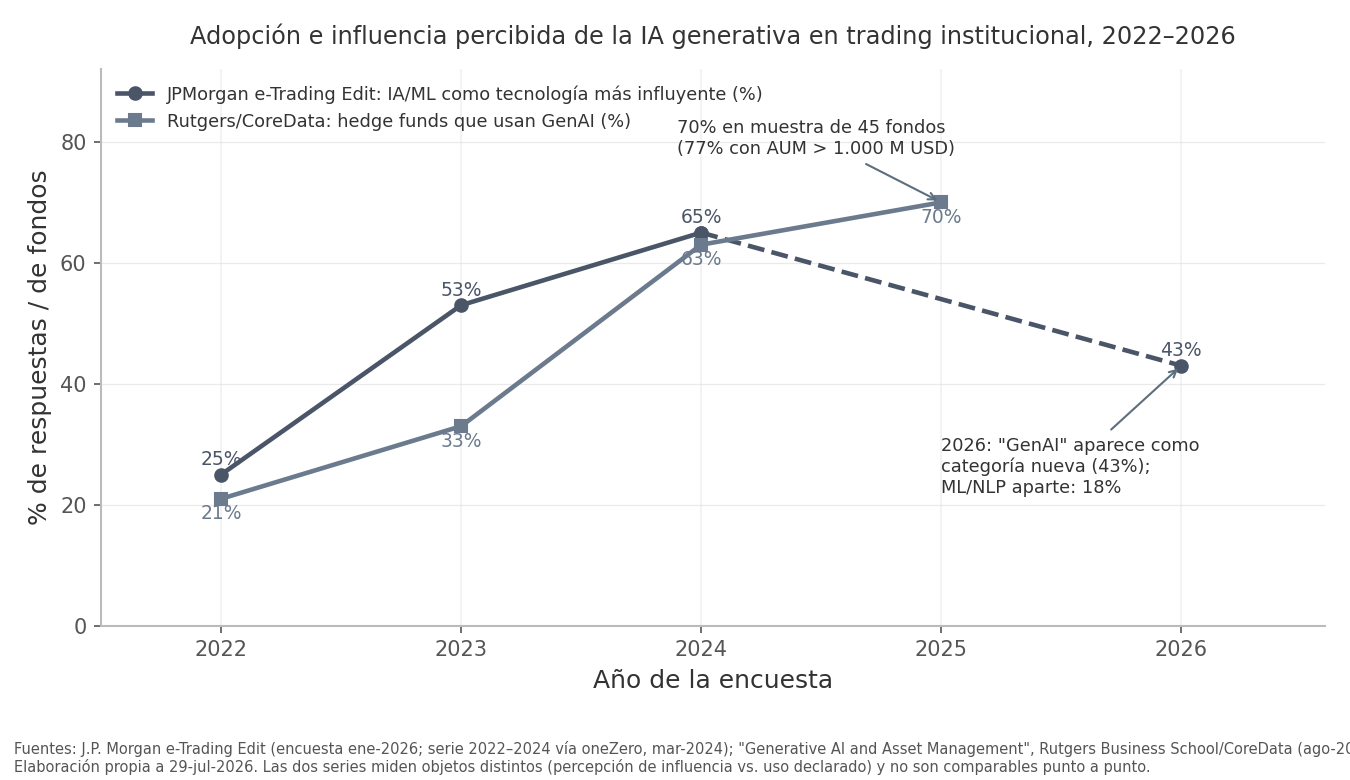
Figure 1.1 — Source: own elaboration from JPMorgan e-Trading Edit (2022–2026 editions, perceived influence) and Rutgers/CoreData (August 2025, self-reported use). Data as of January 2026; the two series are not comparable point by point (see caveats 1–4 below).
The methodological caveats are not optional; they are part of the data:
- The series measure different objects. e-Trading Edit measures perceived future influence, not use; Rutgers/CoreData measures self-reported use for investment purposes. They are not comparable point by point, nor do they compose a single "adoption rate".
- The 2026 point is not a decline. The move from 65% (2024) to 43% (2026) in the JPMorgan series reflects a change of instrument: GenAI was split off from ML/NLP, which led the 2024 and 2025 editions. Combined, both categories concentrate 61% of mentions, in continuity with the prior trend (Medium) .
- The academic sample skews toward large funds. 51% of participants manage more than 10,000 M USD; adoption among emerging managers is presumably lower (galileo.ai) .
- Reported adoption ≠ measurable impact. The EY 2025 survey of wealth and asset managers finds that 95% of firms have scaled GenAI to multiple use cases and 78% are exploring agentic AI, but only slightly more than a quarter report substantial business impact (fintechstudios.com) .
One final figure from the same academic source illustrates why prudence is this course's editorial norm: a differences-in-differences test on 13F positions associates adopting hedge funds with 2% to 4% higher annualized abnormal returns than non-adopters (galileo.ai) . It is the best econometric evidence available of real value —and it is still association, not causation: the January 2025 version of the same paper estimated 3–5%, the revision lowered it, and the authors themselves warn that the effect concentrates in large funds with AI talent and dilutes as adoption becomes widespread (galileo.ai) .
1.1.2 Verified institutional cases
Beyond surveys, there is primary evidence —engineering blogs, press releases, customer case studies— of production deployments. The following table orders them by their position in the stack, not by notoriety.
Table 1.1 — Documented institutional LLM deployments with primary source (as of July 2026)
| Firm | System (year) | Documented function | Stack layer |
|---|---|---|---|
| Kensho / S&P Global | "Grounding" (2026) | Multi-agent router on LangGraph: decomposes queries into domain-specific sub-queries for Data Retrieval Agents and aggregates answers; multi-stage evaluation with exact-match | Understand (data access) (IDEAS/RePEc) |
| Bloomberg | ASKB (2026, beta) | Agent network in the Terminal: synthesizes structured data, documents, news, and research with source attribution and exportable BQL code | Understand / reason (stevens.edu) |
| JPMorgan | LLM Suite (2024) | Internal ChatGPT-style assistant for ~50,000 employees (~15% of headcount), described as "a research analyst"; antecedent: IndexGPT trademark (2023) | Understand (metacto.com) |
| BlackRock | Aladdin Copilot (2024) | Copilot scoped to the Aladdin perimeter: it gives no investment advice, anti-hallucination filters by design | Understand (risk) (arXiv.org) |
| Man Group (Numeric) | AlphaGPT (2025) | Agentic 3-role workflow (ideas → Python code → statistical evaluation); signals must clear the same thresholds as human research | Reason (hypothesis generation) (Pynions) |
| Bridgewater | AIA Labs (2024) | Macro fund of ~2,000 M USD with machine-primary decision-making, PM sign-off, and kill switch; 11.9% in 2025 per press reports | Act (governed) (LaunchDarkly) |
| AQR | ML in Apex (2025) | ML feeds ~1/5 of the signals of the flagship multi-strategy fund; earnings-call parsing and signal weighting | Reason (signals) (LangChain) |
| Balyasny | BAM Platform (2023–2026) | ~95% of investment teams use it; "Central Bank Speech Analyst": macro analysis from 2 days to ~30 minutes | Understand / reason (🦜️🔗 LangChain) |
| Point72 | Turion (2024) | Dedicated AI strategy that outperformed the flagship fund in 2025; internal marketplace of fine-tuned models | Reason / act (🦜️🔗 LangChain) |
The correct reading of the table is structural, not chronological. None of these systems is an "autonomous trader" in the sense of the academic literature: the mass deployments (JPMorgan, BlackRock) are deliberately scoped assistants with explicit perimeters; the idea-generation deployments (Man, Balyasny) scale the hypothesis and coding phase, not validation, which remains human and subject to thresholds identical to those of traditional research (Pynions) . Even the most radical experiment —Bridgewater AIA— limits the machine to the macro regime, keeps dashboards that force the manager's sign-off and a stop switch, and its own co-CIO, Greg Jensen, states that using LLMs to pick stocks is "hopeless" because of their inability with causality and their hallucination problem (LaunchDarkly) . The pattern that emerges is not "replace the manager" but "build a comprehension and orchestration layer over proprietary data, with human veto at every capital-intensive decision point".
In institutional practice — Kensho/S&P Global: the multi-agent router as data infrastructure
Kensho, S&P Global's AI engine, published in March 2026 the architecture of "Grounding", its production multi-agent framework built on LangGraph. A router receives the natural-language query, decomposes it into domain-specific sub-queries, and routes them to Data Retrieval Agents (DRA) maintained by the equity research, fixed income, or macroeconomics data teams; the partial answers are aggregated in a map-reduce pattern (IDEAS/RePEc) . On top of that layer operate an equity research assistant and an ESG compliance agent. Three engineering decisions make the case a reference: (i) multi-stage evaluation —routing, data quality, and completeness are evaluated separately, with exact-match metrics on routing and tool-calling, not just another LLM's judgment—; (ii) observability with tracing of every execution; (iii) a common data protocol across teams (IDEAS/RePEc) . The same infrastructure feeds the MCP (Model Context Protocol) server with which S&P Global exposes Capital IQ Financials, earnings call transcripts, and company intelligence to Claude (July 2025) and to a verified ChatGPT app (February 2026), with the contractual guarantee that licensed data is not used to train models (🦜️🔗 LangChain) . The strategic lesson: the large providers no longer compete only for the terminal, but to be the grounding layer of the LLMs their clients use.
1.1.3 Where proven ROI is — and where it is not
The adoption evidence and the academic evidence point to the same frontier. Among adopting hedge funds, 91% use GenAI to process and analyze data and text (news, earnings calls) and 65% to support investment decisions (screening, idea generation, optimization); only ~15% have trained or fine-tuned their own models (galileo.ai) . The largest realized savings concentrate in compliance, risk management, and IT, not in the front office (fintechstudios.com) . In middle office, the empirical rule is the clean-data rule: settlements and investor-custodian reconciliation —functions with structured data and volume— already deliver measurable results, with reconciliation engines that automate over 99% of matches and leave the analyst ~10 high-risk exceptions; NAV oversight and alternatives accounting still depend on human judgment (🦜️🔗 LangChain) .
In price prediction, by contrast, there is no comparable evidence. In the FinBen benchmark (NeurIPS 2024), the best evaluated model reaches ~0.54 accuracy in forecasting stock market movements —barely above chance— and the authors themselves call it a "notable deficiency" (TokenMix) . The documented institutional position agrees: GenAI compresses research and operations costs; it is not a market prediction machine (LaunchDarkly) .
Two figures circulate in the press as a counter-narrative, and this course uses them with an explicit label. The MIT NANDA report (The GenAI Divide, August 2025) estimates that 95% of enterprise GenAI pilots show no measurable impact on the income statement despite 30,000–40,000 M USD of investment (LangChain中文版文档) ; and S&P Global reports, according to press sources, that 42% of AI initiatives were abandoned before production in 2025, versus 17% the previous year (🦜️🔗 LangChain) . Both are qualified press narrative, not hard data: NANDA is not peer-reviewed and "no measurable impact" often means "no measurement baseline"; the S&P figure arrives via secondary sources. They are cited because they delimit the real risk of AI programs, not because they constitute statistically precise measurement.
Risk note — limitations of the adoption figures
All of section 1.1 rests on self-reported surveys, customer case studies published by vendors (OpenAI/Balyasny, LangChain/Kensho), and financial press. Three documented biases: (i) publicity survivorship bias —firms publicize successes; failures arrive anonymized via consultancies, like the European stock screener abandoned because it could not explain to compliance why it favored certain small caps (towardsai.net) ; (ii) non-auditable methodologies —the MIT NANDA 95% and S&P 42% figures have opaque methodological traceability and are used here only as qualified narrative (LangChain中文版文档) ; (iii) marketing regulatory risk —in March 2024 the SEC brought its first AI washing actions (Delphia: 225,000 USD; Global Predictions: 175,000 USD) against advisers claiming nonexistent AI capabilities (博客园) . Every claim about adoption or returns must be read with its date, its sample, and its publication channel.
In plain terms: what "proven ROI" means
When the course says that a function has "proven ROI" it means something very specific: a real organization measured before and after and published the result. An earnings call summary that went from 2 hours to 10 minutes is measurable savings. By contrast, "the model predicted the market" almost never survives examination: either it does not discount costs, or it looks backward with data that did not exist at the time (look-ahead), or it simply has not been independently replicated.
The practical rule that will be used throughout the course:
- Understand (read, summarize, classify, extract): ROI demonstrated again and again.
- Reason (hypotheses, signals, views): conditional ROI — it works as analyst support, not as an oracle.
- Act (execute, move money): only governed, with deterministic math and human sign-off. No documented exceptions in serious production.
1.2 The quant's new role: from models to agentic systems
1.2.1 Capability map: understand, reason, act
The 2026 institutional LLM stack is organized into three capability layers, with a cross-cutting governance layer. Understand covers the ingestion and retrieval of unstructured information: documentary RAG (retrieval-augmented generation) over filings, transcripts, and news, entity extraction, and synthesis with source attribution —the territory of Kensho Grounding, ASKB, and 91% of real use cases (galileo.ai) . Reason covers agents that invoke tools (tools): metric calculators, optimizers, data APIs, code interpreters; the LLM orchestrates deterministic steps and tools —the territory of AlphaGPT and of the multi-strategy platforms (Pynions) . Act covers governed execution: portfolio construction and rebalancing, order routing, always after deterministic controls and human approval —the territory, with explicit limits, of Bridgewater AIA (LaunchDarkly) .

Autonomy grows downward in the stack with increasing validation requirements: documentary comprehension tolerates sample review; reasoning demands systematic evaluation; action demands determinism, pre-trade limits, and human veto. This gradation is not an aesthetic preference: it is the only structure compatible with the numerical reliability of the models and with the supervisory accountability framework in force.
Common pitfall: confusing "capable" with "reliable"
A model can be capable of producing a brilliant analysis once and still not be reliable enough to produce it a thousand times in a row. In finance the unit of measure is not the demo, it is the error rate in production with an associated cost. That is why the understand → reason → act map does not order tasks by how impressive they are, but by where the limit of the error is measured: in "understand" the error is corrected with exact-match and evaluation; in "act" the error is a real loss — hence the human veto.
1.2.2 The golden rule: the LLM reasons, the math decides, the human vetoes
Three independent lines of evidence converge on the same architectural pattern, which constitutes the backbone of this course.
The first line is academic. FinCon (NeurIPS 2024), the agent framework with the best venue pedigree, does not leave risk control to the LLM: it implements risk gating with CVaR (Conditional Value at Risk, expected loss in the tail) at 1% as a constraint external to the model, alongside a manager-analyst hierarchy (Github) . ThesisAgent, an operative variant of the multi-agent frameworks, explicitly separates reasoning from decision: the LLM produces reasoning traces and a "Decision Hub" layer fuses signals and allocates capital with deterministic math; its authors document that the full LLM pipeline produces decisions identical, at the action level, to those of the purely mathematical framework —the LLM adds interpretability, it does not change the math (LangChain中文文档) .
The second line is numerical reliability. LLMs make errors in open-book financial arithmetic: on FinanceBench, GPT-4-Turbo with retrieval answered incorrectly or refused to answer 81% of financial questions (Docs by LangChain) , and FinCon admits hallucinations in production, such as nonexistent memory event indices (Github) . A system that lets the LLM calculate VaR or sizing inherits that error rate at the point of maximum damage.
The third line is regulatory. ESMA expects AI used in algorithmic trading to be integrated into the annual self-assessment of MiFID II RTS 6 and has made it explicit that responsibility is transferred neither to the model nor to the provider (Docs by LangChain) . The operational consequence: someone with a name and legal responsibility must be able to veto every decision with capital impact.
Hence the course's golden rule: the LLM reasons, the math decides, the human vetoes. The LLM reads, summarizes, proposes, and orchestrates; risk metrics, portfolio optimization, and sizing are computed with deterministic code; and final approval —through a human-in-the-loop (HITL) interrupt— precedes any order. Every applied module of the course implements this pattern.
The full flow of a governed decision
The golden rule is not a slogan: it is an architecture. This is how a real decision flows through the three layers — note that the LLM never touches the last mile:

Two details that matter in production: everything that is discarded is logged (it is evidence for audit and for improving the prompts), and the human who signs sees the full reasoning, not just the final recommendation.
1.2.3 What the community believes and what it does not
The academic literature of LLM trading agents (2023–2026) reports extraordinary results. The independent replication literature documents why those numbers are not deployable strategies. Both are true about different objects, and the following table puts them face to face.
Table 1.2 — Self-reported results vs. replication and audit literature (as of July 2026)
| Self-reported claim | Source | Counter-evidence / audit | Source |
|---|---|---|---|
| TradingAgents: cumulative return 26.62% and Sharpe ratio 8.21 on AAPL (Jan–Mar 2024) | (🦜️🔗 LangChain) | The authors themselves admit the Sharpe exceeds the plausible empirical range (3-month window without corrections); 11 LLM calls and >20 tool calls per prediction | (langchain.js) |
| FinCon: cumulative return 113.84%, Sharpe 3.269 (Oct 2022–Jun 2023) | (Github) | Results not independently replicated; admitted hallucinations in multi-asset management | (Github) |
| HedgeAgents: 70% annualized, 400% in 3 years | (arXiv.org) | The same team later documents the "profit mirage": returns evaporate when the model's knowledge window ends | (arXiv.org) |
| Lopez-Lira & Tang: Sharpe 3.8 (GPT-4) on sentiment long-short, >500% cumulative | (arXiv.org) | No transaction costs; the Sharpe changes across paper versions (3.8 → 3.28); the first author himself later published The Memorization Problem | (arXiv.org) |
| The LLM edge holds out of sample | — | FINSABER (20 years, >100 symbols): edges deteriorate; conservative in bull markets, aggressive in bear markets | (arXiv.org) |
| Agents manage capital live | — | DeepFund (live post-cutoff trading): DeepSeek-V3 and Claude-3.7-Sonnet with net losses | (arXiv.org) |
| Backtests are auditable | — | Audit of 77 studies: none reaches the top reproducibility tier; a minority documents temporal splits, costs, or survivorship | (Interactive ML) |
The correct interpretation of the table is not nihilistic. The star numbers share four documented weaknesses —short window, absence of costs, parametric or corpus information leakage, and absence of independent replication— and the most insidious leakage channel is the parametric one: an LLM evaluated on data prior to its training cutoff date can "remember" the future through its weights, a form of look-ahead bias with no classical analog that inspecting the pipeline code cannot rule out (arXiv.org) . The classic skeptical framework applies, moreover, with even more force to three-month windows: McLean and Pontiff measure average degradations of 26% out of sample and 58% post-publication in published predictors, and Bailey and López de Prado's Deflated Sharpe Ratio shows that ~3 backtest attempts are enough to manufacture spurious significance (Github) . The Sharpe ratio governing that correction is defined as
where \(R_p\) is the portfolio return, \(R_f\) the risk-free rate, and \(\sigma_p\) the volatility of the excess return; a Sharpe of 8.21 would imply, with ordinary market volatility, a return consistency without precedent in the history of the modern hedge fund —which is itself a methodological red flag (langchain.js) . The 2026 institutional consensus, articulated by The Alpha Illusion, is that these architectures are valuable as research scaffolding —roles, debate, layered memory, risk gating— and as generators of signals integrable into classic quantitative stacks, but not as autonomous capital managers: "a plausible investment narrative is not a tradable probability" (ProfitLogic) . This course adopts exactly that position: it teaches the architectures as design patterns and uses their metrics as an exercise in critical validation.
1.3 How to use this course
1.3.1 Audience, prerequisites, and itinerary
The course is aimed at three profiles working on the same pipeline: the quant developer, who will build the agents and needs command of LangChain v1, LangGraph, and evaluation; the risk manager, who must know what can go wrong, how an agentic system is governed, and what evidence to demand; and the portfolio manager, who consumes the outputs and retains the veto. The prerequisites are fluent Python (functions, classes, virtual environments), pandas for series and table manipulation, and basic quantitative finance: returns, volatility, Sharpe ratio, drawdown, notions of backtesting. No prior experience with LLMs is assumed.
The fifteen modules are grouped into four blocks that replicate the capability map of section 1.2.1 with increasing validation requirements:
- Block I — Foundations (M2–M3): LangChain v1 and
create_agent; agents and state graphs with LangGraph. - Block II — Understand (M4–M6): financial data sources, documentary RAG aware of financial structure, prompt engineering for financial tasks.
- Block III — Reason and decide (M7–M9): quantitative risk with deterministic tools, portfolio construction, signals, and backtesting with anti-leakage discipline.
- Block IV — Act with governance (M10–M12): governance and observability, production deployment, and the integrative capstone project.
The lab environment is uniform: Python 3.12, langchain v1.x, langgraph, pandas, numpy, and a market data provider with a free tier; each module includes executable notebooks, versioned datasets, and FinanceBench-style evaluation golden datasets. The editorial conventions are those already seen in this module: every figure carries a date and a source; every paper metric is presented with its window, its costs, and its replication status; and every agent the reader builds will end in a human-approval interrupt before touching capital, even simulated.
Exercises
-
Code — reproduce and extend the adoption series. Rebuild the
m1_adopcion.pngchart from the data cited in 1.1.1. Add a third series with the EY 2024 (52% of hedge funds with GenAI deployed (Quanthedge AI) ) and EY 2025 (95% of WAM firms with scaled adoption (fintechstudios.com) ) points. Document in a markdown cell why the three series do not admit a common axis without caveats. -
Critical analysis — the decline that wasn't. A press analyst headlines "AI enthusiasm falls 22 points in institutional trading (65% → 43%)". Write a 200-word rebuttal using the evidence from 1.1.1, including the exact question the survey asks and what changed in the 2026 instrument (Medium) .
-
Critical analysis — reading press statistics. Take the MIT NANDA (95% (LangChain中文版文档) ) and S&P Global (42% (🦜️🔗 LangChain) ) figures. For each one, identify: measurement design, operational definition of "failure", publication channel, and which conclusion can and cannot be drawn. Propose what measurement you would run in your own organization to avoid falling into the "no measurable impact" category.
-
Design — map a use case to the stack. Choose a real process from your function (e.g., earnings call summarization, risk monitoring, reconciliation). Draw its flow over the understand → reason → act diagram, marking: what the LLM does, which deterministic tool it invokes, where it is evaluated with exact-match, and where the HITL interrupt goes. Justify each boundary with the rule from section 1.2.2.
-
Critical analysis — express audit of a paper. Apply Table 1.2 as a checklist to TradingAgents (🦜️🔗 LangChain) : window, costs, backbone cutoff, universe, result selection. Compute the minimum Sharpe the authors' own empirical criterion would require (SR > 3 = excellent) and discuss what additional evidence would be needed to take the result seriously.
-
Design — Kensho-style evaluation. Design on paper a golden dataset of 50 queries for a financial data router: 10 per domain with its correct DRA labeled. Specify the routing exact-match metric, a failure criterion for tool-calling, and how you would integrate the evaluation into CI (continuous integration) before each deployment (IDEAS/RePEc) .
Module 1 of 15 — LangChain for Quantitative Trading. Data and versions verified as of July 2026; prices and market figures subject to change. LangChain 1.3.14 / langchain-core 1.5.2.
Elite resources to go deeper
- LangChain v1.0 — official release notes: what exactly changed in v1 and why it matters when reading 2024–2025 code.
- JPMorgan e-Trading Edit: the annual survey the module uses; read the exact question before citing any figure.
- Kensho (S&P Global) — engineering blog: grounding cases and multi-agent routers told by those who built them.
- arXiv — TradingAgents: the paper behind the bull/bear/judge debate that will reappear in module 3; read it alongside the replication critiques.
- NIST AI Risk Management Framework: the governance vocabulary that will return in module 10.
Check your understanding
Self-assessment with instant feedback. No scores are stored: it is just for you.